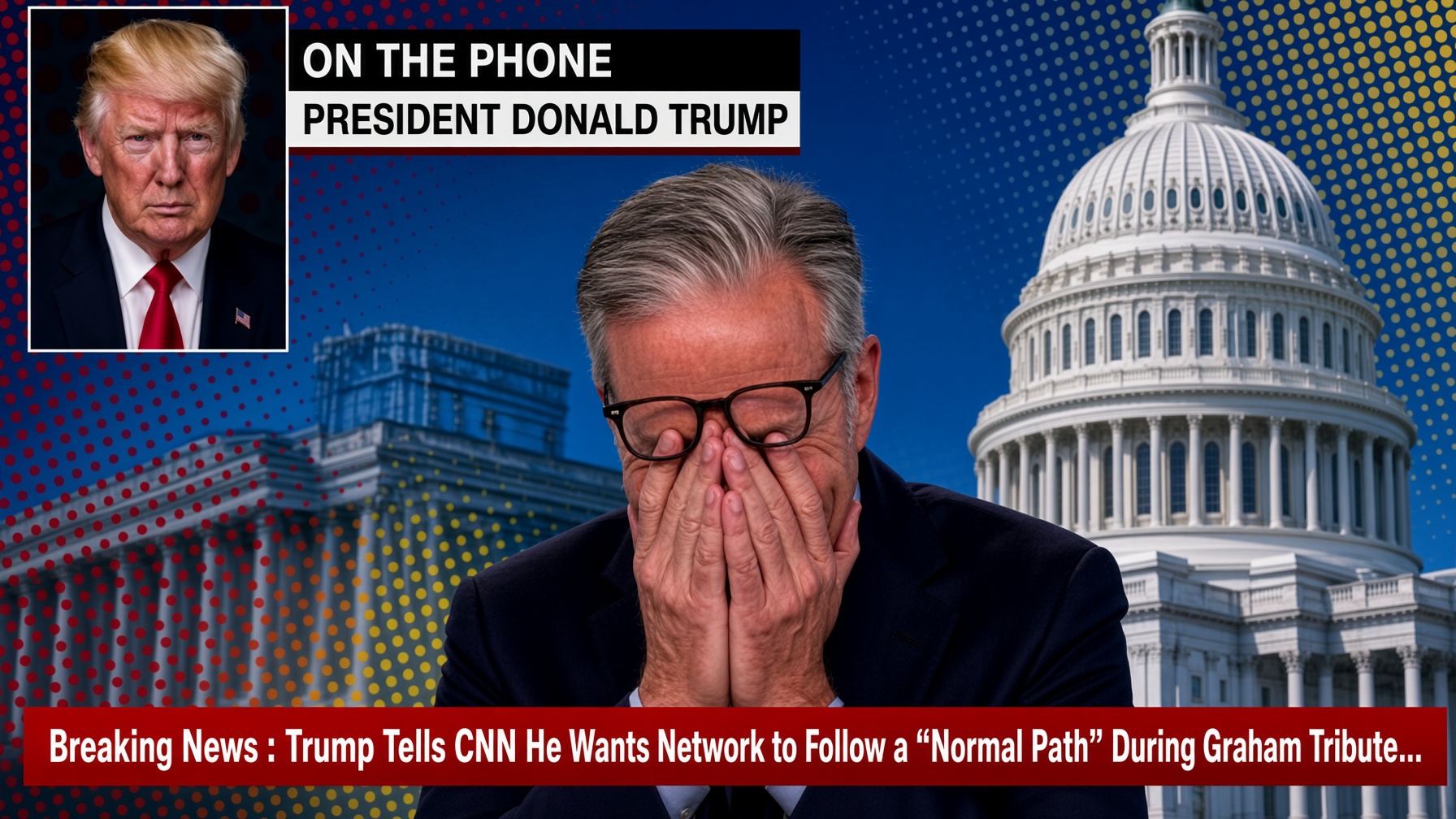
WASHINGTON — In an unscripted exchange that quickly reverberated across the national media landscape, President Donald Trump used a surprise live appearance on CNN to reignite his long-running critique of the cable news network, asserting an intention to steer the broadcaster toward what he characterized as a “normal path.”
The unsolicited remark capped a brief telephone call-in to CNN’s flagship Sunday public affairs broadcast, State of the Union, on July 12, 2026. Trump broke an extended, multi-year boycott of the network’s live programs to deliver on-air tributes following the sudden death of U.S. Sen. Lindsey Graham, the influential South Carolina Republican and key legislative confidant to the White House who passed away at 71 on July 11 after a brief illness (1.1.1, 1.1.4).
Anchor Jake Tapper directed the bulk of the dialogue toward Graham’s congressional legacy, his international defense policy footprint, and his decades in the Senate (1.1.12). When Tapper attempted to steer the discussion toward pressing national security flashpoints, including intensifying military confrontations involving Iran, Trump declined to engage, stating that he called exclusively to honor his late colleague.
As the segment concluded, Tapper extended a customary invitation for the president to return for a comprehensive, on-the-record sit-down interview.
“I will,” Trump replied. Before the host could transition to a commercial break, the president delivered a sharp assessment of CNN’s editorial posture.
“We’re trying to have CNN go on a normal path,” Trump said in an off-the-cuff yet pointed sign-off. “And we will do that.”
Tapper immediately defended the network’s editorial integrity: “Well, I’m on a normal path right here, sir, and I appreciate your time.”
“Good. You are,” Trump said before ending the call.
A DECADELONG ADVERSARIAL DYNAMIC
The exchange drew immediate scrutiny throughout the capital because it represented the first unscripted, direct interaction between the president and the network in years. Since entering the national political arena in 2015, Trump has maintained an overtly combative posture toward CNN, regularly labeling the channel “fake news” and making its reporting a central target in his campaign against perceived legacy media bias.
The president’s remark contained no technical detail, operational roadmap, or explicit regulatory ultimatum. Trump did not delineate specific broadcast standards he considers abnormal, nor did he suggest a formal legal mechanism through which the executive branch would intervene in private newsroom decision-making.
Media ethicists noted that while the statement does not indicate imminent, state-directed regulatory censorship, it provided an unfiltered window into the president’s enduring conviction that legacy broadcast networks operate with ideological hostility toward his agenda—and that his administration holds a legitimate stake in challenging their news agendas.
CONSOLIDATION PRESSURES AND EDITORIAL FIREWALLS
The timing of Trump’s comments arrived amid significant structural turbulence across the parent company of the 46-year-old news brand. CNN’s corporate owner, Warner Bros. Discovery, is actively navigating a monumental corporate transition that could reshape the American media ecosystem.
The Department of Justice’s Antitrust Division confirmed in June that it had cleared Paramount Skydance’s proposed $110 billion acquisition of Warner Bros. Discovery, determining that the combined entertainment conglomerate would not violate federal anti-monopoly statutes. If the transaction secures final regulatory approvals, the merger will bring two foundational broadcast journalism entities—CNN and CBS News—under a single corporate hierarchy.
The prospective mega-merger has triggered concerns among press-freedom advocates, media labor guilds, and communications regulators regarding corporate concentration, operational redundancies, and newsroom autonomy. To address those antitrust and public-interest inquiries, Paramount Skydance leadership agreed to establish an independent, five-member editorial review board charged with safeguarding the journalistic firewalls and reporting standards at both networks.
That arrangement has attracted skepticism among First Amendment legal scholars. Critics question whether an oversight council selected within an integrated corporate framework can insulate newsrooms from commercial and political pressures, particularly when dealing with an executive branch that routinely challenges the statutory licenses and business practices of major media owners.
AN INTERDEPENDENT, COMBATIVE RELATIONSHIP
The Sunday broadcast underscored the complex, mutually reactive dynamic that continues to bind Trump to the cable network. While the president regularly weaponizes grievances against CNN to mobilize his political base, he recognized the network’s reach as an effective medium to commemorate a high-profile ally (1.1.12).
CNN, meanwhile, balanced its journalistic responsibility to cover the commander-in-chief with the operational risk of airing an unscripted caller who has systematically disputed the network’s institutional credibility. Tributes to Graham have poured in from both sides of the aisle, emphasizing his stature as a political force (1.1.12).
“While Senator Graham’s passing has briefly united Washington in grief, the on-air tension between the president and Tapper is a stark reminder of the fragile relationship between the White House and the press,” a veteran media analyst said.
First Amendment analysts caution against interpreting the brief on-air sign-off as concrete evidence of administrative interference in programming. The phrase “normal path” functions as an ideological inkblot, interpreted by administration allies as a benign call for editorial neutrality and by press-freedom advocates as a subtle threat against aggressive reporting.
Nevertheless, as the network navigates a high-stakes corporate integration, the exchange served as a clear reminder that its future trajectory remains under close scrutiny from an executive branch eager to exert its influence over how modern political journalism is produced and framed.